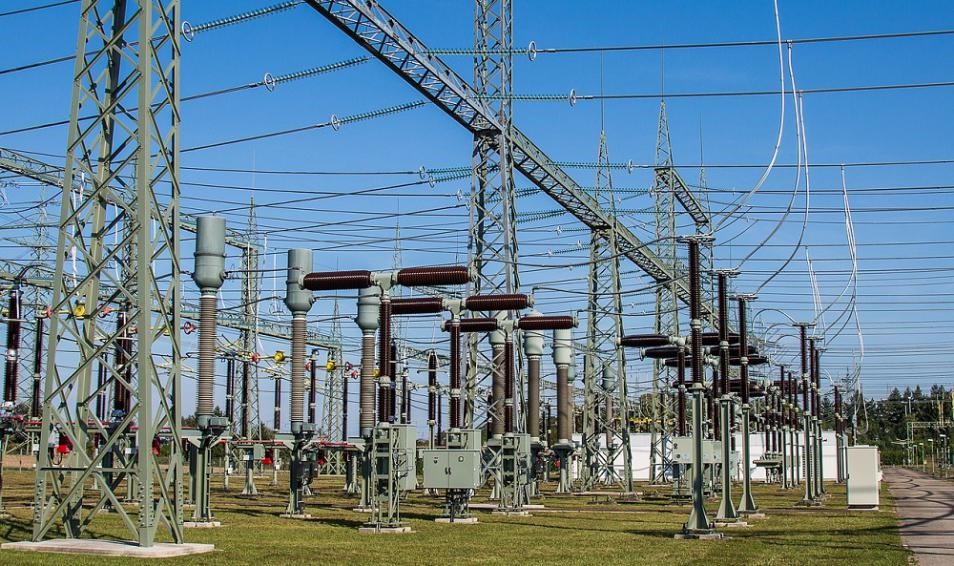
An electrical substation is used for stepping AC voltage up or down for transmission
or distribution. The high voltage is stepped up or down using transformers. A typical
electrical substation
steps down the high AC transmission voltage (typically between 69 kV and 765 kV) to
a lower voltage for distribution (typically between 4 kV and 35 kV). Large ceramic
high-voltage insulators are
often used at substations to prevent electrical arcing. Switchgear can also often be
found at electrical substations, and is used to interrupt electrical faults.
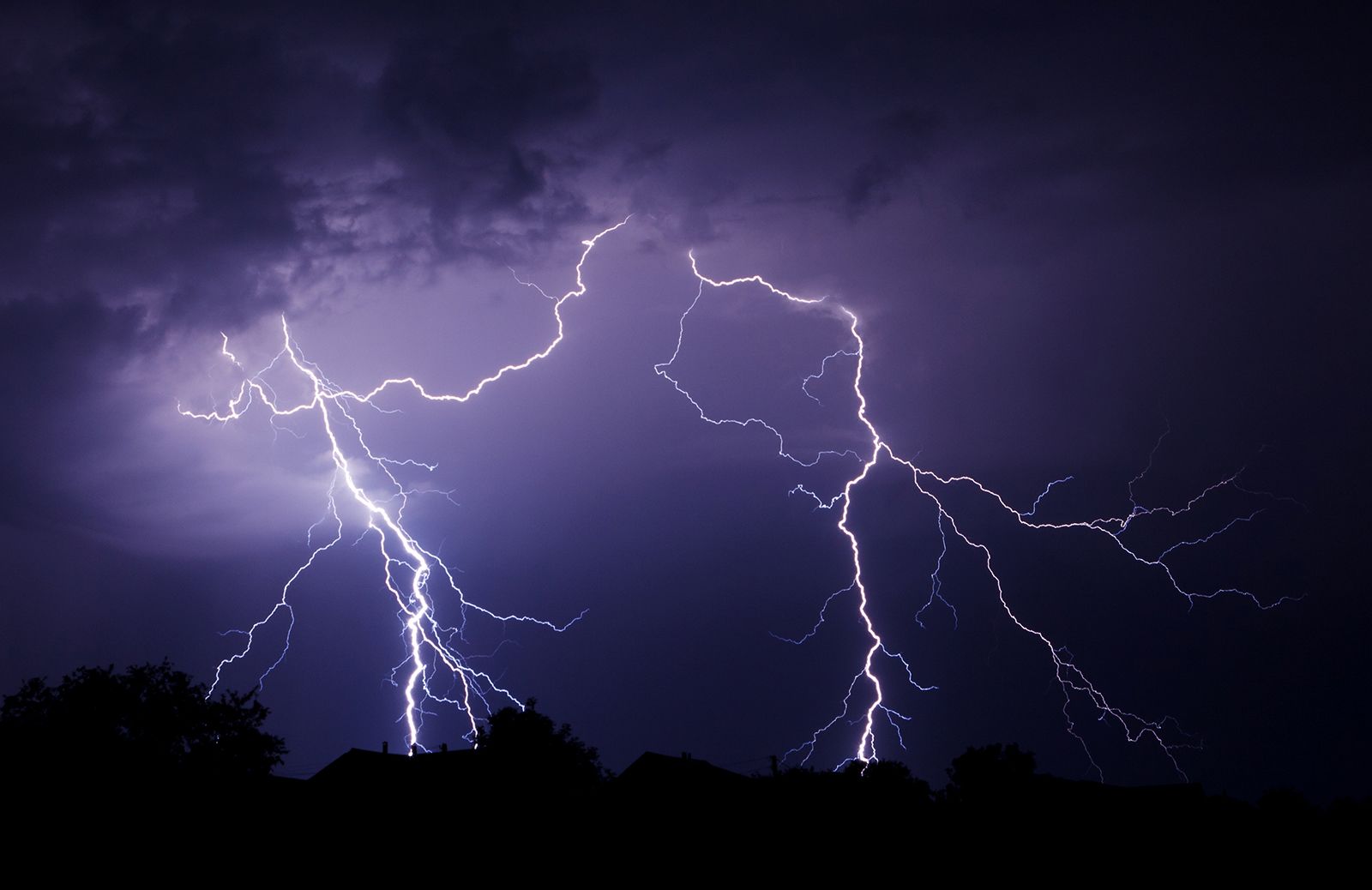
A lightning strike is a natural high-voltage discharge which occurs as
a result of the difference in voltage between the negatively-charged base
of a cloud and the positively-charged
ground. The voltage found in a lightning strike is typically between 100
million to 300 million volts (100 - 300 MV), but can be as high as over 1
billion volts (1 GV) in extreme cases.
The current found in a lightning strike is typically around 30,000
amperes (30 KA). While most lightning strikes are negative, originating from
the negatively-charged base of a cloud,
some lightning strikes are positive. Positive lightning strikes are more
intense than negative lightning strikes, and originate from the positively-charged
top part of a cloud.
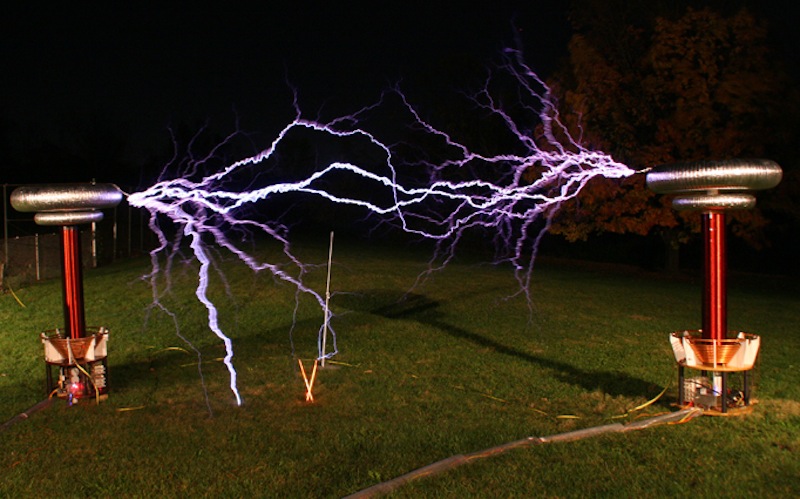
The spark-gap Tesla coil was invented by Nikola Tesla in 1891. A Tesla coil is a
type of resonant transformer capable of generating very high AC voltages. A spark gap
Tesla coil consists of a high-voltage capacitor,
a primary coil, a secondary coil, a spark gap, a top load, and a high-voltage input
transformer. There have since been many variations of the Tesla coil circuit, such as the
solid-state Tesla coil, the dual-resonant solid-state
Tesla coil, and the vacuum tube Tesla coil.
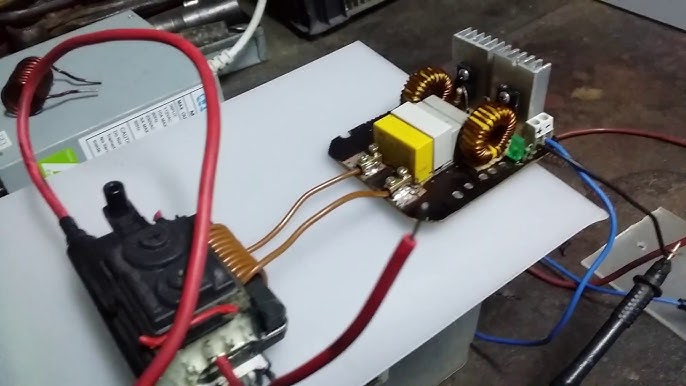
The ZVS driver was invented by Vladimiro Mazzilli. It is a type of resonant circuit
commonly used for driving flyback transformers, creating high-voltage electrical discharges.
It is popular
among electronics hobbyists as it is relatively simple and has a low-voltage input. It is
usually paired with a DC-output high-voltage flyback transformer from a CRT TV. However, it can
be used to
drive AC-output flyback transformers as well. A tutorial on how to build the ZVS driver circuit
can be found above.